Azalea Asset Management (“Azalea”) just hosted its Astrea Investor Day 2024 on 6 February 2024. Azalea’s Chief Investment Officer, Mr. Chue En Yaw, provided an overview of the Private Equity market over the recent years, while the Director of Investor Solutions and Marketing, Mr. Lim Jun Jie, gave updates on the performance of the various Astrea portfolios.
We
have summarized some of the key points highlighted during Astrea Investor Day
2024 below. For investors who may be interested in the full presentation, the
webcast may be found on Azalea’s website here.
The Private Equity Market
Azalea is a wholly-owned subsidiary of Seviora, and indirectly owned by Temasek Holdings (Private) Limited. It focuses on the investments of private equity (“PE”) funds, to make PE investments more accessible to a broader group of investors.
2023 had been yet another difficult year for PE, with global deals and total transaction value continuing to fall since 2021. Rising interest rates heavily impacted PE activities, where typically PE managers are highly sensitive to existing interest rates, given the impact it has on carrying out deals.
Despite
a difficult period for the PE market, PE continues to outperform the broader
public markets. Across the period of March 2019 to September 2023, PE saw a
cumulative performance of +103% (gauged using the PrEQIn Quarterly Index) -
outperforming the likes of the S&P 500 and MSCI World Index with total
returns of +63% and +48% respectively. During 2022 where we saw the initial
rate hikes, Mr. Chue highlighted that private equity had been more resilient than
the public markets with lesser declines. Looking forward, he expects the
outperformance to continue in a lower interest rates environment.
The Astrea PE Bonds
The Astrea bonds are asset-backed securities, which in this case, are backed by cash flows generated from investing in PE funds. The cash flows generated will be used to make interest payments and to pay the principal of these bonds. In 2023, Azalea saw the successful redemption of Astrea IV PE bonds – a significant milestone that marks the first completion of an Astrea product offered to retail bond investors.
For most Astrea portfolios, the Class A-1 bonds (denominated in SGD) are offered to the retail investors while the remaining tranches are offered to other investors. The Class A-1 bonds are of the highest seniority across the various tranches. Payment made to Class A-1 bonds, including redemption, will be prioritized over the rest. Launched in 2022, the Astrea 7 marks the first offering of Class B bonds (denominated in USD) to retail investors, which offers a higher coupon in exchange for the higher risk on lower bond seniority. This allowed retail investors to have an additional option, depending on their risk preferences.
Additionally, the Class A-1 bonds are of 10MC5 structure – maturity of 10 years but with a mandatory call date at the end of the fifth year. The mandatory redemption is contingent on whether sufficient reserves are present in the Reserves Account, and no existing loans on the credit facilities at the point of redemption. In the event of a non-call, bondholders are compensated with a step-up in coupon rates, of typically 1%.
Astrea bonds are one of the few products available in Singapore that provides exposure to PE. While the asset-backed structure is relatively uncommon, the Astrea bonds have structural safeguards in place to provide protection for bondholders. Some serve to improve the likelihood of the bonds’ redemption, while others mitigate the downside risk in the event of a shortfall in cash flows. The structural safeguards are detailed below –
- Reserves Account – Cash is required to be set aside in the Reserves
Account for building up sufficient reserves to redeem the bonds on the
mandatory call date. Distribution into the Reserves Account is made before
distributions are provided to the equity investors. This further helps to
ensure that bondholders are prioritized over equity investors.
- Sponsor Sharing (currently for Astrea V and VI) – After meeting the
performance threshold, the clause on Sponsor Sharing will be triggered. This
requires 50% of the cash flow to the Sponsor to be allocated to the Reserves
Account (until the cap is met), enabling a faster build-up of reserves to
redeem the bonds on the mandatory call date.
- Maximum Loan-to-Value (“LTV”) Ratio – The LTV cap is at 50%, which
largely serves as a trigger to accelerate the payments into the Reserves
Account. In the case of a valuation decline that triggers the 50% cap, payments
to equity investors will be redirected to the Reserves Account instead.
- Credit Facility – The portfolio may draw on the credit facility it has with DBS Bank Ltd to fund certain expenses, other amounts payable (including unpaid accrued interest on bonds) and capital calls.
Lastly,
while the payment distribution order might not be a structural safeguard
itself, we believe the order of distribution greatly helps with prioritizing
the bondholders. After accounting for fund expenses, interest payments are
first made to bondholders, subsequently into the Reserves Account, and lastly followed
by the Sponsor after all prior clauses are paid. On top of the structural
safeguards, it is rather clear that Azalea focused on the protection of
bondholders’ interests when designing the Astrea portfolios – a highly
attractive point despite its complexity.
Astrea portfolios’ performance
Astrea V
Chart 1
Astrea
V Portfolio NAV Movements (USD m)
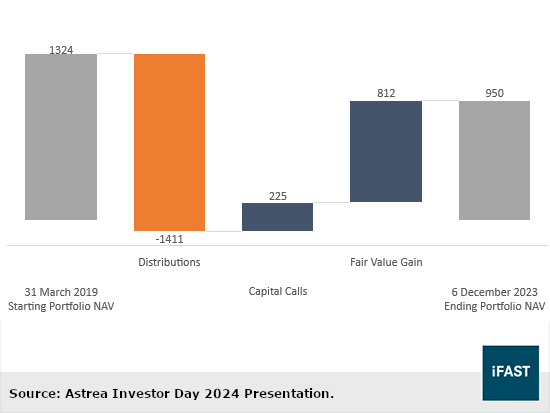
Since
its issuance in March 2019, Astrea V have seen strong overall performance. As
of 6 December 2023, the cash distributions of USD 1,411m represent
approximately 107% of the initial portfolio NAV, while seeing quite significant
fair value gains of USD 812m. The Astrea V portfolio has been fully reserved
for Class A bonds as of 20 June 2023, while the performance threshold was met
as of 20 December 2021.
As such, the Astrea V Class A-1 bonds ASTLC 3.850% 20Jun2029 Corp (SGD) is expected to be redeemed on the mandatory call date of 20 June 2024. With the performance threshold met, a bonus redemption premium of 0.5% of the principal amount will be paid to Class A-1 bondholders alongside the redemption of bonds.
Astrea
VI
Chart 2
Astrea
VI Portfolio NAV Movements (USD m)
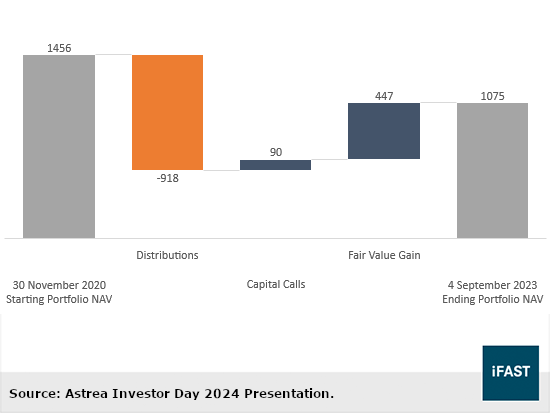
As
of 4 September 2023, the Astrea VI portfolio has made distributions totalling
to approximately 63% of the initial portfolio NAV, while 60% of the Class A
bonds have been reserved in the Reserves Account. The LTV ratio is at 31.4%,
holding a relatively substantial buffer to the 50% cap. Previously, it had
announced that the performance threshold has been met as of 18 September 2022,
which should further help to accelerate the accumulation of reserves for Class
A bonds.
Astrea
7
Chart 3
Astrea
7 Portfolio NAV Movements (USD m)
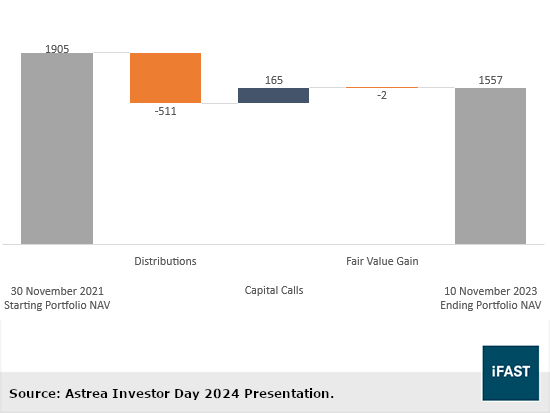
As
of 10 November 2023, the Astrea 7 has made cash distributions amounting to
approximately 27% of the initial portfolio NAV, while 30% of the Class A bonds
have been reserved. The LTV ratio remains mostly stable at 38.2%, against the
initial portfolio LTV of 40%.
Credit rating upgrades
Chart 4
Upgrade
on credit ratings for various Astreas’ portfolios by S&P and Fitch Ratings
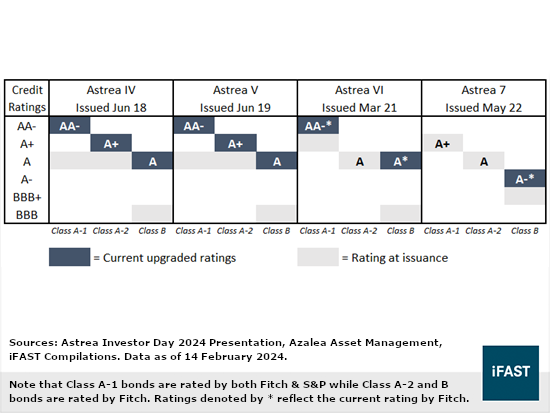
The Astrea PE bonds have seen credit rating upgrades with the accumulation of reserves, which provides an additional layer of assurance to bondholders. Just recently, the Astrea portfolios saw the latest credit rating upgrade by Fitch Ratings on 14 February 2024. For retail investors, it has upgraded Astrea VI Class A-1 bonds ASTLC 3.000% 18Mar2031 Corp (SGD) from ‘A+ sf’ to ‘AA- sf’, while Astrea 7 Class B bonds ASTLC 6.000% 27May2032 Corp (USD) has upgraded from ‘BBB+ sf’ to ‘A- sf’.
Fitch
noted that the rating upgrade on ASTLC 3.000% 18Mar2031 Corp (SGD) was due to
the accumulated reserves, which has now exceeded the outstanding principal
amount of the Class A-1 bonds. For ASTLC 6.000% 27May2032 Corp(USD), the
upgrade was due to the prevailing LTV ratios, which passed Fitch’s cash flow
scenarios. Furthermore, Fitch highlighted that the portfolios are expected to
withstand weak performance in its underlying funds in the event of adverse
market cycles.
Recommendations
Table 1
Astrea
Class A-1 SGD Bonds
|
Issue |
Ask Price |
Yield to Call/ Maturity |
Years to Call/ Maturity |
|
100.36 |
2.74%/ 4.67% |
0.34/ 5.34 |
|
|
97.93 |
4.05%/ 3.96% |
2.09/ 7.09 |
|
|
100.70 |
3.94%/ 4.59% |
3.28/ 8.28 |
|
|
Sources: Bondsupermart, iFAST Compilations. Note the bonus redemption premium of 0.5% for Astrea V and VI are not included in the calculations of the yield. Data as of 16 February 2024. |
|||
Across the various Class A-1 options, we prefer the ASTLC 3.000% 18Mar2031 Corp (SGD) given the current progress on the accumulation of reserves and the bonus redemption premium. It also offers a relatively attractive yield to call, with about 2 years remaining to call (mandatory call date of 18 March 2026). We expect the bond to be redeemed on the mandatory call date. The bond will be great for retail investors seeking a good alternative to fixed deposits, particularly given the credit rating at ‘AA- sf’.
Declaration: For specific disclosure, at the time of publication of this report, IFPL (via its connected and associated entities) holds a position in ASTLC 3.250% 18Mar2031 Corp (USD) - Class A-2, and the analyst who produced this report holds a NIL position in the abovementioned securities.
Our podcast series, Yield Hunters, is available on Spotify, iTunes Podcasts and Google Podcasts. We share our thoughts on new bond issues and hold discussions on the fixed income space. Listen to our latest episode below and follow us!